DeepLagField: Time-Varying AR Reconstruction#
This tutorial demonstrates training a neural network to infer the order \(p\) and time-varying coefficients \(a(t)\) of TVAR processes:
Goals:
Generate synthetic TVAR data with known ground-truth coefficients
Train
DeepLagFieldto jointly predict AR order and coefficient trajectoriesEvaluate classification and regression accuracy across coefficient families
import torch
from torch.utils.data import DataLoader, TensorDataset
from sklearn.metrics import confusion_matrix, ConfusionMatrixDisplay
import numpy as np
from tqdm import tqdm
import matplotlib.pyplot as plt
import pandas as pd

from NeuralFieldManifold.models import DeepLagEmbed
from NeuralFieldManifold.generators import tvar
from NeuralFieldManifold.utils import train_loop, bench_loop
from NeuralFieldManifold.plottings import plot_history, plot_coefficients_by_p, plot_tvar_sample
from NeuralFieldManifold.generators import (
    sinusoid,
    fourier,
    quasiperiodic,
    polynomial_drift,
    logistic_transition,
    multi_sigmoid,
    gaussian_bumps,
    smooth_random,
)
from torchinfo import summary
from concurrent.futures import ProcessPoolExecutor, as_completed
import multiprocessing
from utils import pinn_processor
Coefficient Schedule Registry#
Eight families control how \(a_k(t)\) evolve over time:
sinusoid / fourier / quasiperiodic: Periodic or near-periodic oscillations
poly_drift / logistic: Smooth trends and transitions
multi_sigmoid / gaussian_bumps: Localized regime changes
smooth_random: Stochastic but differentiable trajectories
# Registry of families you can benchmark
SCHEDULES = {
    "sinusoid": sinusoid,
    "fourier": fourier,
    "quasiperiodic": quasiperiodic,
    "poly_drift": polynomial_drift,
    "logistic": logistic_transition,
    "multi_sigmoid": multi_sigmoid,
    "gaussian_bumps": gaussian_bumps,
    "smooth_random": smooth_random,
}
Data Generation#
Key functions:
simulate_tvar(): Simulates TVAR with soft power clamping to prevent divergencegenerate_one_tvar_sample(): Produces a single \((x, a(t), \text{meta})\) tuple with retry logicgenerate_dataset(): Parallelized generation balanced across families and orders \(p \in \{2,...,6\}\)
def _rng(seed):
    return np.random.default_rng(seed)

def pad_to_pmax(a_time_p, p_max):
    """Pad [T, p_true] -> [T, p_max] with zeros."""
    T, p = a_time_p.shape
    out = np.zeros((T, p_max), dtype=a_time_p.dtype)
    out[:, :p] = a_time_p
    return out

def generate_one_tvar_sample(
    T=10_000,
    p_max=6,
    schedule_name="sinusoid",
    noise_std=0.3,
    seed=0,
    l1_cap=0.95,
    P0=0.5,
    W=40,
    power_control=True,
    p_true=None,  # If provided, use this p; otherwise random
    p_candidates=None,
    max_retries=10000,  # Maximum resampling attempts
):
    rng = _rng(seed)
    if p_candidates is None:
        p_candidates = np.array([2, 3, 4, 5, 6], dtype=int)

    # Use provided p_true or randomly select
    if p_true is None:
        p_true = int(rng.choice(p_candidates))
    else:
        p_true = int(p_true)

    # Retry loop: resample until we get a valid sample
    current_seed = seed
    for attempt in range(max_retries):
        # Use a fresh rng for coefficient schedule each attempt
        attempt_rng = _rng(current_seed)

        # coefficient schedule for true p
        a_tp = SCHEDULES[schedule_name](T=T, p=p_true, rng=attempt_rng)

        # simulate signal with power control (rejection-based)
        x, a_actual = simulate_tvar(
            a_tp, noise_std=noise_std, seed=current_seed+123,
            P0=P0, W=W, power_control=power_control
        )

        # If valid sample (not rejected), break out
        if x is not None:
            break

        # Increment seed for next attempt
        current_seed += 1
    else:
        raise RuntimeError(f"Failed to generate valid sample after {max_retries} retries for schedule '{schedule_name}', p_true={p_true}")

    # pad coeffs to p_max for consistent storage
    a_t = pad_to_pmax(a_actual.astype(np.float32), p_max)

    meta = {
        "T": T,
        "p_max": p_max,
        "p_true": p_true,
        "schedule": schedule_name,
        "noise_std": float(noise_std),
        "seed": int(current_seed),  # Record the seed that actually worked
        "l1_cap": float(l1_cap),
        "P0": float(P0),
        "W": int(W),
        "power_control": power_control,
        "p_candidates": list(p_candidates),
        "retries": attempt,  # Number of retries needed
    }
    return x, a_t, meta

def _generate_sample_worker(args):
    """
    Worker function for parallel sample generation.
    Takes a dict of arguments and returns (idx, x, a_t, meta, cid, ns).
    """
    idx = args["idx"]
    T = args["T"]
    p_max = args["p_max"]
    cname = args["cname"]
    ns = args["ns"]
    s = args["s"]
    P0 = args["P0"]
    W = args["W"]
    power_control = args["power_control"]
    p_true_val = args["p_true_val"]
    p_candidates = args["p_candidates"]
    cid = args["cid"]

    x, a_t, meta = generate_one_tvar_sample(
        T=T, p_max=p_max, schedule_name=cname, noise_std=ns, seed=s,
        P0=P0, W=W, power_control=power_control,
        p_true=p_true_val, p_candidates=p_candidates,
    )

    return idx, x, a_t, meta, cid, ns

def simulate_tvar(a_time, noise_std=0.3, seed=0, burn_in=300,
                  P0=0.5, W=40, power_control=True,
                  divergence_threshold=1e6):
    """
    Simulate a TVAR process with soft power clamping and hard rejection safety net:
        x_t = a(t)^T [x_{t-1}, ..., x_{t-p}] + eps_t

    During simulation, if window power exceeds P0, the current sample is scaled
    by clip(sqrt(P0/power), 0.8, 1.2) to gently steer power back toward the target.
    After simulation, a final hard check rejects if power still exceeds P0.
    """
    rng = _rng(seed)
    T, p = a_time.shape

    T_full = T + int(burn_in)
    x_full = np.zeros(T_full, dtype=np.float64)
    eps = rng.normal(0.0, noise_std, size=T_full)

    x_full[:p] = eps[:p]

    for t in range(p, T_full):
        tau = t - int(burn_in)
        if tau < 0:
            a_t = a_time[0]
        else:
            a_t = a_time[min(tau, T - 1)]

        lags = x_full[t-p:t][::-1]
        x_full[t] = np.dot(a_t, lags) + eps[t]

        # Early divergence check — fail fast instead of letting values blow up
        if abs(x_full[t]) > divergence_threshold:
            return None, None

        # Soft power clamping (matches the working tvar() function)
        if power_control and t >= W - 1:
            window = x_full[t - W + 1:t + 1]
            current_power = np.mean(window ** 2)
            if current_power > 0:
                s = np.clip(np.sqrt(P0 / current_power), 0.8, 1.2)
                x_full[t] *= s

    # Drop burn-in (safe cast now — divergent runs already returned None)
    x = x_full[int(burn_in):].astype(np.float32)

    # Hard rejection safety net: only check full W-sized windows
    # (matches soft clamping which only activates at t >= W-1)
    if power_control and len(x) >= W:
        x2 = x ** 2
        cumsum = np.concatenate([[0.0], np.cumsum(x2)])
        ends = np.arange(W, len(x) + 1)
        starts = ends - W
        power = (cumsum[ends] - cumsum[starts]) / W
        if np.any(power > P0):
            return None, None

    return x, a_time

def generate_dataset(
    n_per_class=10,
    classes=None,
    T=1000,
    noise_range=(0.1, 0.6),
    seed=0,
    dtype=np.float32,
    P0=0.5,
    W=40,
    power_control=True,
    p_candidates=None,
    balanced_p=True,  # If True, balance samples across p_candidates
    n_workers=None,  # Number of parallel workers (None = CPU count)
):

    p_max = 10

    if p_candidates is None:
        p_candidates = np.array([2, 3, 4, 5, 6], dtype=int)
    else:
        p_candidates = np.array(p_candidates, dtype=int)

    if classes is None:
        classes = list(SCHEDULES.keys())

    if n_workers is None:
        n_workers = multiprocessing.cpu_count()

    rng = _rng(seed)
    N = n_per_class * len(classes)

    X = np.zeros((N, T), dtype=dtype)
    A = np.zeros((N, T, p_max), dtype=dtype)
    p_true_arr = np.zeros((N,), dtype=np.int32)
    class_id = np.zeros((N,), dtype=np.int32)
    noise_std = np.zeros((N,), dtype=dtype)

    class_names = list(classes)

    # Precompute p assignments if balanced
    n_p = len(p_candidates)
    if balanced_p:
        n_per_p = n_per_class // n_p
        remainder = n_per_class % n_p
        # Create balanced p assignments for one class
        p_assignments = []
        for i, p in enumerate(p_candidates):
            count = n_per_p + (1 if i < remainder else 0)
            p_assignments.extend([p] * count)

    # Build all task arguments
    tasks = []
    idx = 0
    for cid, cname in enumerate(class_names):
        # Shuffle p assignments for this class
        if balanced_p:
            class_p_assignments = rng.permutation(p_assignments)

        for i in range(n_per_class):
            s = int(rng.integers(0, 2**31 - 1))
            ns = float(rng.uniform(noise_range[0], noise_range[1]))

            # Determine p_true
            if balanced_p:
                p_true_val = int(class_p_assignments[i])
            else:
                p_true_val = None  # Let generate_one_tvar_sample pick randomly

            tasks.append({
                "idx": idx,
                "T": T,
                "p_max": p_max,
                "cname": cname,
                "ns": ns,
                "s": s,
                "P0": P0,
                "W": W,
                "power_control": power_control,
                "p_true_val": p_true_val,
                "p_candidates": list(p_candidates),
                "cid": cid,
            })
            idx += 1

    metas = [None] * N

    # Parallel execution
    with ProcessPoolExecutor(max_workers=n_workers) as executor:
        futures = {executor.submit(_generate_sample_worker, task): task["idx"] for task in tasks}

        with tqdm(total=N, desc=f"Generating samples ({n_workers} workers)") as pbar:
            for future in as_completed(futures):
                idx, x, a_t, meta, cid, ns = future.result()
                X[idx] = x.astype(dtype)
                A[idx] = a_t.astype(dtype)
                p_true_arr[idx] = meta["p_true"]
                class_id[idx] = cid
                noise_std[idx] = ns
                metas[idx] = meta
                pbar.update(1)

    dataset = {
        "X": X,
        "A": A,
        "p_true": p_true_arr,
        "class_id": class_id,
        "class_names": np.array(class_names),
        "noise_std": noise_std,
        "meta": metas,  # Python list of dicts; fine for notebook use
    }
    return dataset

def save_dataset_npz(path, dataset):
    np.savez(
        path,
        X=dataset["X"],
        A=dataset["A"],
        p_true=dataset["p_true"],
        class_id=dataset["class_id"],
        class_names=dataset["class_names"],
        noise_std=dataset["noise_std"],
        meta=np.array(dataset["meta"], dtype=object),
    )

def load_dataset_npz(path):
    d = np.load(path, allow_pickle=True)
    return {
        "X": d["X"],
        "A": d["A"],
        "p_true": d["p_true"],
        "class_id": d["class_id"],
        "class_names": d["class_names"],
        "noise_std": d["noise_std"],
        "meta": list(d["meta"]),
    }
Visualize Schedule Families#
Each schedule produces qualitatively different signals. Top row shows \(x(t)\); bottom row shows the true \(a_k(t)\) coefficients. Note how coefficient dynamics translate into signal structure.
Generate Training Dataset#
Create a balanced dataset: equal samples per family, uniform distribution over \(p \in \{2,3,4,5,6\}\), and noise \(\sigma \in [0.2, 0.5]\). Power control ensures bounded variance.
classes = list(SCHEDULES.keys())

# small pilot: 10 per family => 80 samples total
pilot = generate_dataset(
    n_per_class=10,
    classes=classes,
    T=600,
    noise_range=(0.2, 0.5),
    seed=123,
    dtype=np.float32
)
# save_dataset_npz("train_data.npz", pilot)
X_train, coef_train, p_train, class_id_train, X_val, coef_val, p_val, class_id_val, class_names = pinn_processor("train_data.npz", family=None)
Total samples: 1000000 | Train: 800000 | Val: 200000
Train p distribution: {np.int64(0): np.int64(160000), np.int64(1): np.int64(160000), np.int64(2): np.int64(160000), np.int64(3): np.int64(160000), np.int64(4): np.int64(160000)}
Val p distribution:   {np.int64(0): np.int64(40000), np.int64(1): np.int64(40000), np.int64(2): np.int64(40000), np.int64(3): np.int64(40000), np.int64(4): np.int64(40000)}
Prepare DataLoaders#
Move tensors to GPU upfront to eliminate per-batch transfer overhead. The model expects shape (batch, T) for signals and (batch,) for order labels.
device = torch.device('cuda:1' if torch.cuda.is_available() else 'cpu')
if device.type == 'cuda':
    torch.cuda.init()
    torch.backends.cudnn.benchmark = True
    print(f"Using device: {device}")

# Move ALL data to GPU upfront - eliminates CPU->GPU transfer bottleneck
X_train = torch.tensor(X_train, dtype=torch.float32, device=device)
p_train = torch.tensor(p_train, dtype=torch.long, device=device)
X_val = torch.tensor(X_val, dtype=torch.float32, device=device)
p_val = torch.tensor(p_val, dtype=torch.long, device=device)
class_id_val = class_id_val  # numpy array

# Data already on GPU - no pin_memory/workers needed
train_loader = DataLoader(
    TensorDataset(X_train, p_train),
    batch_size=256,
    shuffle=True
)
val_loader = DataLoader(
    TensorDataset(X_val, p_val),
    batch_size=256
)
Using device: cuda:1
Define Training Configuration#
Loss function combines:
lambda_p: Cross-entropy for order classificationlambda_ar: MSE between predicted and true coefficientslambda_energy: Penalizes large coefficient magnitudes within the prediction windowlambda_smooth: Encourages temporally smooth \(\hat{a}(t)\)
def do_bench_on_config(lambda_config, model=None):

    # hyperparameters
    n_epochs = 100
    lr = 1e-3
    max_ar_order = 6

    if model is None:
        # Model: n_classes=5 for p∈{2,3,4,5,6}, max_ar_order=6 for coefficient dimensions
        model = DeepLagEmbed(seq_len=600, n_classes=5, max_ar_order=6, hidden_dim=128)
        model = model.to(device)
        # summary(model, input_size=(32, 600), device=device)

    # Train
    history = train_loop(
        model, train_loader, val_loader,
        n_epochs=n_epochs, lr=lr,
        lambda_p=lambda_config["lambda_p"], lambda_ar=lambda_config["lambda_ar"], lambda_energy=lambda_config["lambda_energy"],
        lambda_smooth=lambda_config["lambda_smooth"], lambda_order=lambda_config["lambda_order"],
        p_max=max_ar_order, device=device
    )
    return model, history
Train Model#
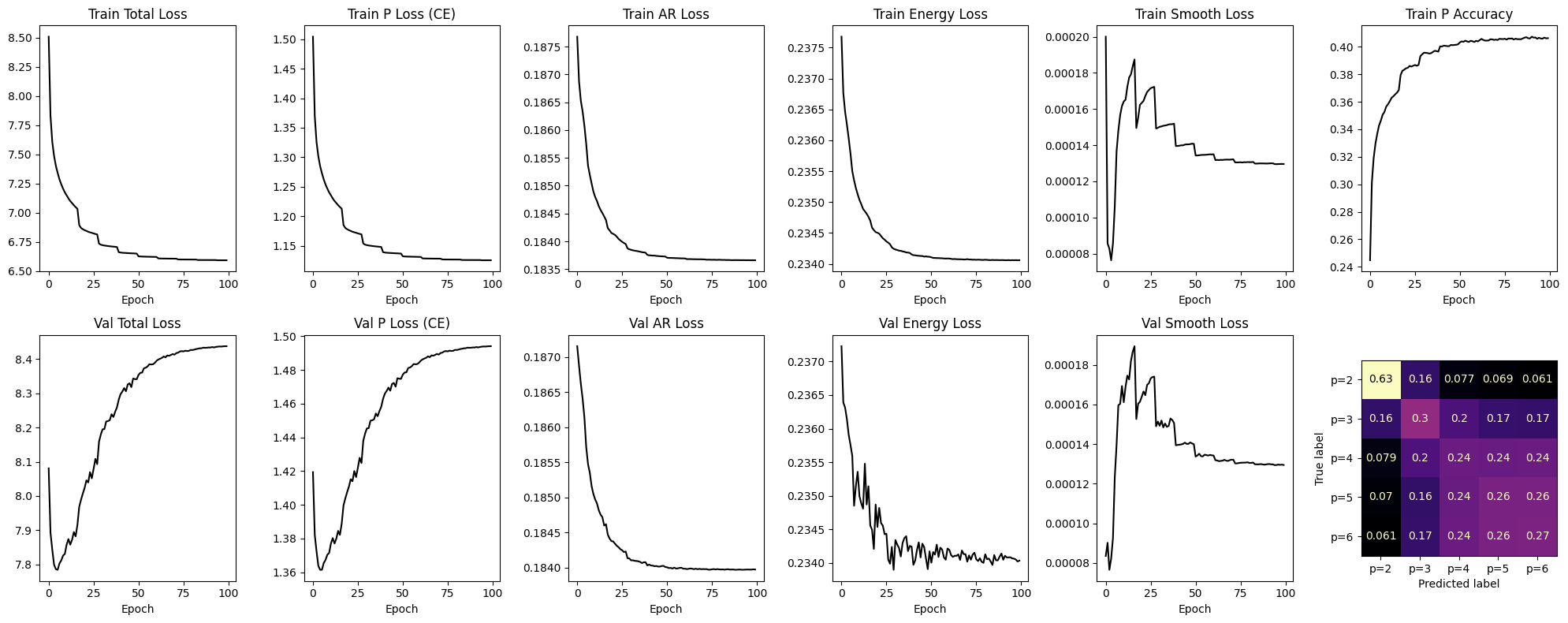
Train for 100 epochs with balanced loss weights. The training curve shows joint convergence of classification and regression objectives.
conf = {
    "lambda_ar": 5,
    "lambda_p": 5,
    "lambda_order": 0,
    "lambda_energy": 0.2,
    "lambda_smooth": 5,
}

model, history = do_bench_on_config(conf)
plot_history(history, model=model, val_loader=val_loader, device=device)
Training: 100%|██████████| 100/100 [14:56<00:00, 8.96s/it, p_acc=0.340, train=6.5934, val=8.4380]
Evaluation: Order Classification#
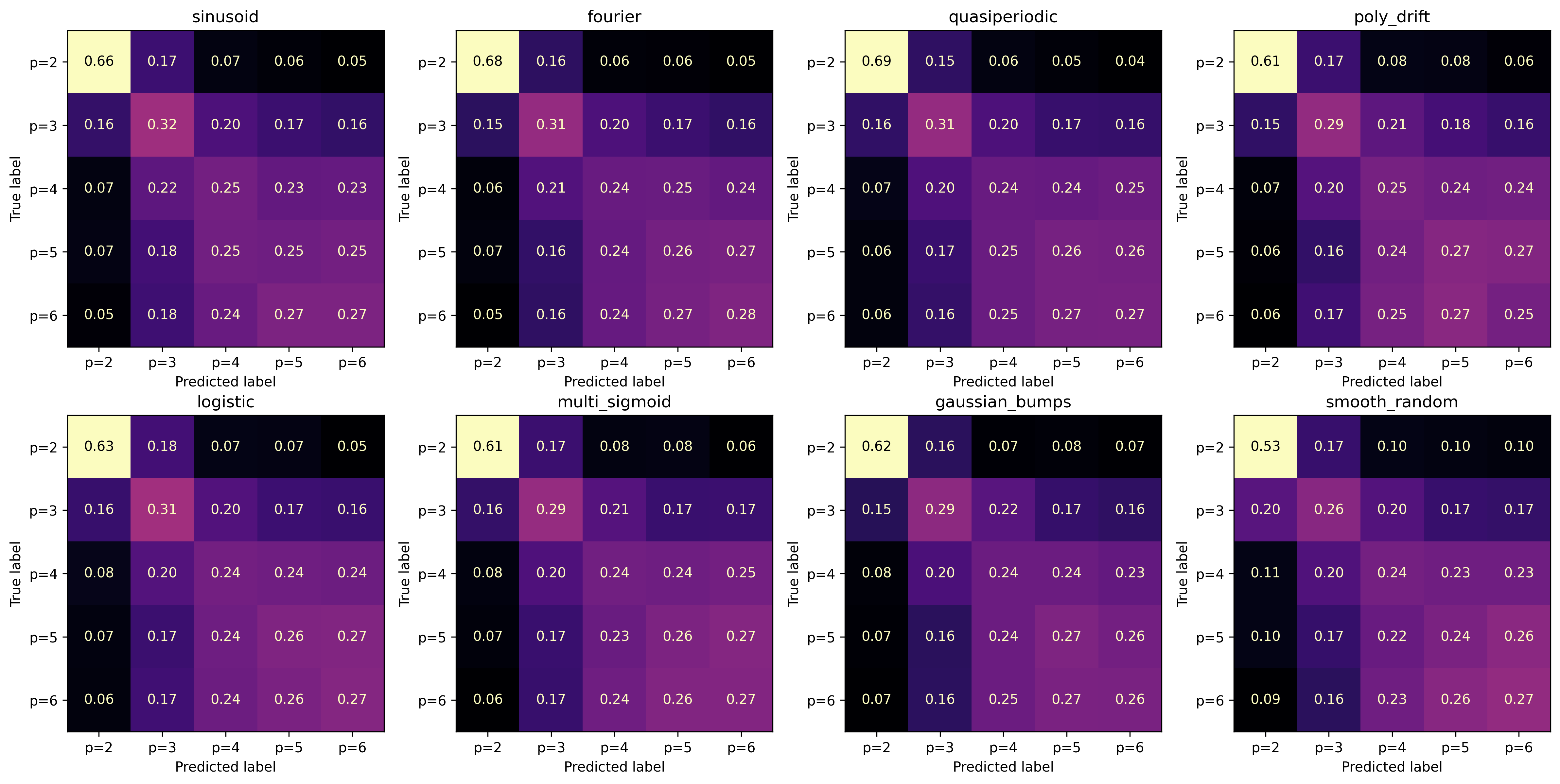
Confusion matrices show how well the model distinguishes AR orders within each family. Diagonal dominance indicates correct classification; off-diagonal mass reveals systematic over/under-estimation of \(p\).
# Get predictions on full validation set
model.eval()
all_p_pred = []
all_p_true = []

with torch.no_grad():
    for x_batch, p_batch in tqdm(val_loader, desc="Getting predictions"):
        x_batch = x_batch.to(device)
        _, _, p_hard, _ = model(x_batch)
        all_p_pred.extend(p_hard.cpu().numpy())
        all_p_true.extend(p_batch.cpu().numpy())

all_p_pred = np.array(all_p_pred)
all_p_true = np.array(all_p_true)
Getting predictions: 100%|██████████| 782/782 [00:00<00:00, 795.68it/s]
# Plot confusion matrix for each signal family
n_families = len(class_names)
nrows, ncols = 2, 4
fig, axes = plt.subplots(nrows, ncols, figsize=(4 * ncols, 4 * nrows), dpi=300)
axes_flat = axes.flatten()

p_min, p_max = 2, 6
n_classes = p_max - p_min + 1

family_results = {}

for i, family_name in enumerate(class_names):
    mask = class_id_val == i
    p_true_family = all_p_true[mask]
    p_pred_family = all_p_pred[mask]

    # Compute normalized confusion matrix
    cm = confusion_matrix(p_true_family, p_pred_family, labels=range(n_classes))
    cm_norm = cm / cm.sum(axis=1, keepdims=True)

    # Store accuracy for this family
    family_results[family_name] = {
        'accuracy': np.mean(p_true_family == p_pred_family),
        'n_samples': len(p_true_family)
    }

    # Plot
    disp = ConfusionMatrixDisplay(cm_norm, display_labels=[f'p={j+p_min}' for j in range(n_classes)])
    disp.plot(ax=axes_flat[i], cmap='magma', colorbar=False, values_format='.2f')
    axes_flat[i].set_title(f'{family_name}')

# Hide unused subplots
for j in range(n_families, nrows * ncols):
    axes_flat[j].set_visible(False)

plt.tight_layout()
plt.show()
Benchmark: Coefficient Recovery#
Metrics per family:
coeff_mse: Mean squared error of \(\hat{a}(t)\) vs true \(a(t)\)
signal_mse: One-step prediction error using estimated coefficients
p_acc: Classification accuracy for each order
family_bench_results = {}

for i, family_name in enumerate(class_names):
    mask = class_id_val == i
    X_family = X_val[mask].cpu()  # Move to CPU for bench_loop
    coef_family = coef_val[mask][:, :, :6]  # Slice to max_ar_order=6
    p_family = p_val[mask].cpu()

    results = bench_loop(model, X_family, coef_family, p_family, device)
    family_bench_results[family_name] = results

# Display as DataFrame
family_bench_df = pd.DataFrame(family_bench_results).T
family_df = family_bench_df.rename(columns={
    'coeff_mse': 'coeff mse',
    'signal_mse': 'signal mse',
    'p_mae': 'delta p',
    'p_mape': 'delta p / p',
    'p2_acc': 'p=2',
    'p3_acc': 'p=3',
    'p4_acc': 'p=4',
    'p5_acc': 'p=5',
    'p6_acc': 'p=6',
    'p_acc': 'P Avg.',
})
family_bench_df
| coeff_mse | signal_mse | p_mae | p_mape | p2_acc | p3_acc | p4_acc | p5_acc | p6_acc | p_acc | |
|---|---|---|---|---|---|---|---|---|---|---|
| sinusoid | 0.003924 | 0.183046 | 1.085483 | 0.290002 | 0.661209 | 0.326721 | 0.241122 | 0.251023 | 0.267625 | 0.351111 |
| fourier | 0.004272 | 0.184083 | 1.069846 | 0.284058 | 0.679984 | 0.316788 | 0.244737 | 0.274840 | 0.280372 | 0.358101 |
| quasiperiodic | 0.004035 | 0.182153 | 1.063116 | 0.281938 | 0.684039 | 0.310689 | 0.247123 | 0.272243 | 0.277012 | 0.356821 |
| poly_drift | 0.004315 | 0.183816 | 1.109580 | 0.302322 | 0.618354 | 0.300617 | 0.248848 | 0.262569 | 0.266481 | 0.340402 |
| logistic | 0.003673 | 0.183003 | 1.106807 | 0.300061 | 0.629938 | 0.296878 | 0.240559 | 0.260685 | 0.267918 | 0.339890 |
| multi_sigmoid | 0.003155 | 0.182505 | 1.132916 | 0.309419 | 0.607890 | 0.296363 | 0.244748 | 0.260765 | 0.269086 | 0.336374 |
| gaussian_bumps | 0.003542 | 0.183888 | 1.123097 | 0.302140 | 0.624358 | 0.305849 | 0.248492 | 0.266004 | 0.264642 | 0.340380 |
| smooth_random | 0.007759 | 0.189260 | 1.221906 | 0.343524 | 0.523409 | 0.258195 | 0.228875 | 0.251690 | 0.265594 | 0.305647 |
Visualize Coefficient Predictions#
Overlay of predicted \(\hat{a}_k(t)\) (dashed) and true \(a_k(t)\) (solid) for representative samples. Good fits track the ground-truth dynamics; discrepancies highlight challenging regimes.
# Plot coefficient predictions for each signal family
for i, family_name in enumerate(class_names):
    mask = class_id_val == i
    X_family = X_val[mask].cpu()
    coef_family = coef_val[mask][:, :, :6]
    p_family = p_val[mask].cpu()

    plot_coefficients_by_p(model, X_family, coef_family, p_family, device,
                           p_max=6, p_min=2, title=f"Family: {family_name}")







